If you’ve ever planned a direct instruction lesson and found yourself wondering, “Am I teaching a skill or a concept?” you’re not alone. Understanding the difference between procedural and declarative lessons can completely change the clarity and effectiveness of your teaching.
Both are part of Direct Instruction (DI): an approach built on teacher clarity, explicit modeling, guided practice, and independent application. But the type of learning goal you’re targeting determines which structure fits best.
Let’s break it down!
What Is a Procedural Direct Instruction Lesson?
A procedural lesson focuses on how to do something. It’s all about teaching a skill or process. Something students can perform or demonstrate.
Think:
- How to divide fractions
- How to write a complete sentence
- How to use quotation marks
- How to measure volume with a graduated cylinder
These lessons are built around steps and actions. The teacher models the process explicitly, provides guided practice, and then releases students for independent practice.
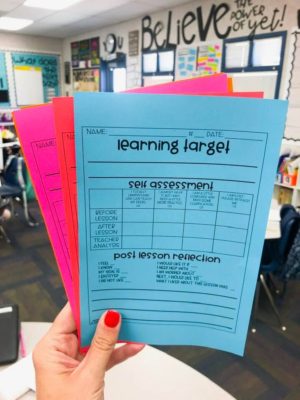
Learning Goal Example:
- Students will be able to multiply a fraction by a whole number using the area model.
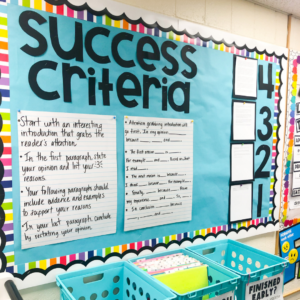
Success Criteria:
- I can explain the steps in order.
- I can simplify fractions.
- I can check my work for accuracy.
Teacher Tip:
Procedural lessons are perfect for building fluency and confidence. Model the process visually, think aloud, and provide corrective feedback that focuses on sequence and accuracy.
What Is a Declarative Direct Instruction Lesson?
A declarative lesson focuses on what something is or why it happens. These lessons help students build conceptual understanding and background knowledge.
Think:
- What a simile is
- Why the American Revolution began
- What renewable and nonrenewable resources are
- How the water cycle works
Declarative lessons are about facts, vocabulary, and relationships between ideas. Teachers model examples and nonexamples, explain the “why,” and guide students in classifying or explaining concepts.
Learning Goal Example:
- Students will be able to explain the difference between physical and chemical changes.
Success Criteria:
- I can describe the concept accurately.
- I can give examples and nonexamples.
- I can explain why my example fits the concept.
Teacher Tip:
Declarative lessons are great for concept-building. Use visuals, analogies, and short formative checks like “Which one doesn’t belong?” to help students connect ideas.
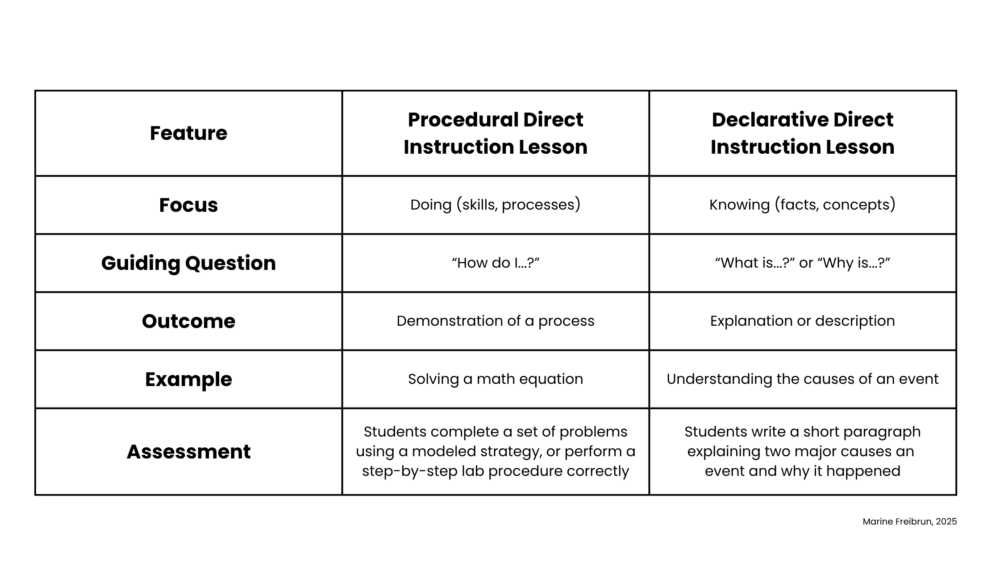
Procedural vs. Declarative at a Glance
How They Work Together
The best lessons often blend both. When teaching students how to solve a word problem, for example, they need declarative knowledge (understanding which operation to use) and procedural skill (applying the steps to solve it).
When teachers identify the type of learning goal, they can plan clearer modeling, practice, and feedback, leading to more confident, independent learners.
Lesson Planning Made Easier
Here’s a simple reflection you can use during planning:
“By the end of this lesson, do I want students to know something or do something?”
- If it’s know, you’re teaching a declarative lesson.
- If it’s do, you’re teaching a procedural lesson.
This one question helps you define your learning goal, design clearer success criteria, and plan meaningful practice opportunities.
Final Thoughts
Teacher clarity begins with knowing what we’re teaching and how. Whether it’s procedural or declarative, direct instruction helps students understand the goal, see it modeled, and practice it with confidence.
When we’re clear about our purpose, our students can be clear about theirs.
Want to Dig Deeper?
If you’d like editable templates for direction instruction lessons (and other free teacher clarity resources), subscribe to my newsletter here and I’ll send them straight to your inbox!